

EDU REKHA INTERNATIONAL PUBLISHER (ERIP) is an international, online, open-access scholarly publishing house committed to disseminating high-quality academic and research literature to the global scholarly community.
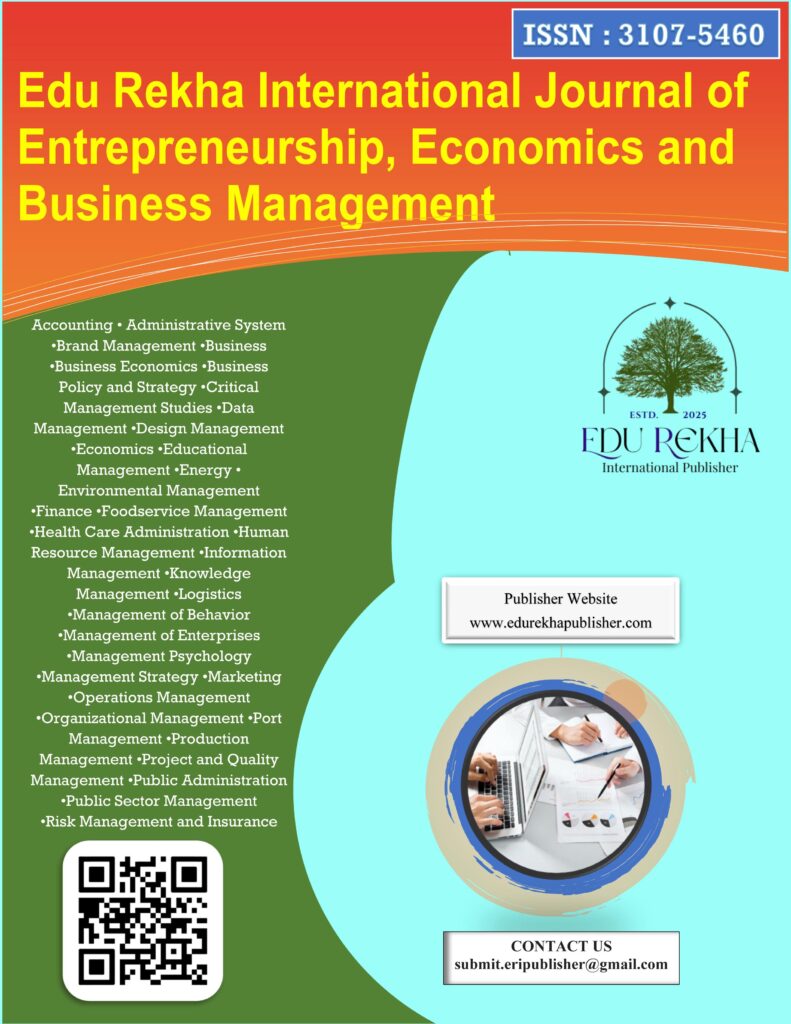
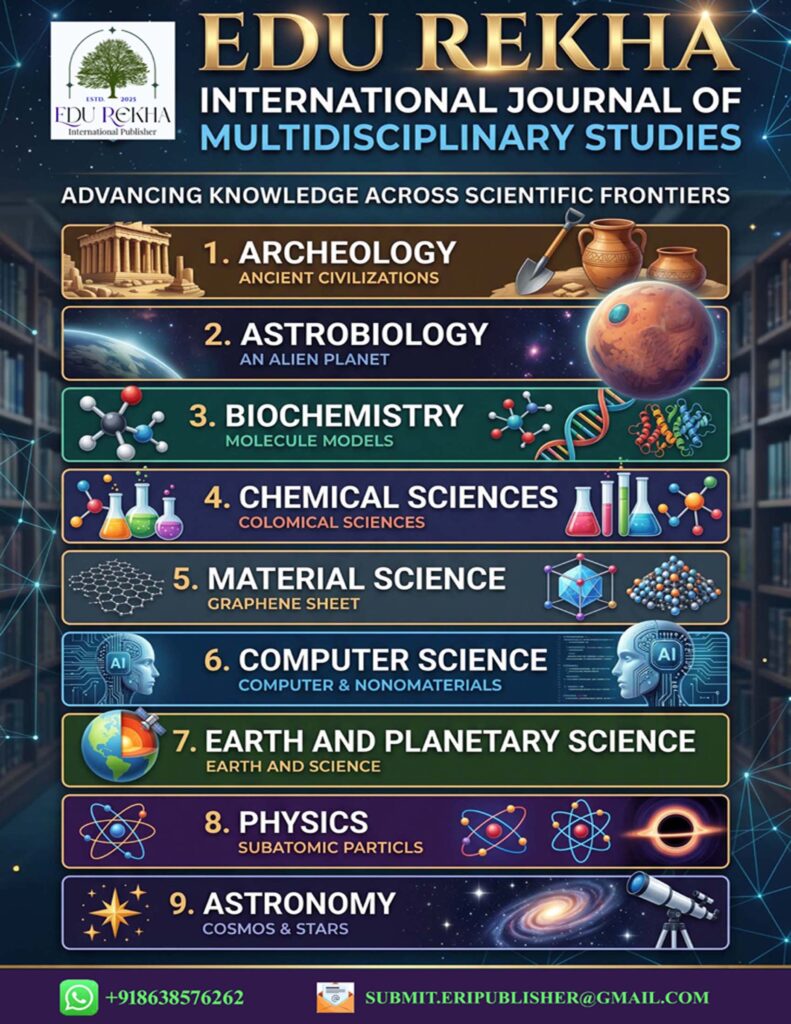
ERIP publishes research across a broad range of disciplines, including Social Sciences, Economics, Management, Humanities, General Science, Medical and Healthcare Sciences, Engineering Sciences, and Multidisciplinary Studies.
The primary aim of ERIP is to provide a reliable platform for the publication and dissemination of original research articles, review articles, short communications, case studies, special issues, and other scholarly contributions.
ERIP invites researchers, academicians, scholars, and professionals from around the world to submit their original and unpublished research to suitable journals within its publishing portfolio. We are committed to facilitating the effective exchange of knowledge by connecting researchers and their findings with a wider international audience.
More than a publisher, ERIP seeks to serve as a bridge between researchers and the global academic community, helping valuable research reach readers across geographical and disciplinary boundaries.
The EDU REKHA INTERNATIONAL PUBLISHER (ERIP) is committed to supporting the advancement of knowledge and promoting scholarly communication across diverse academic and scientific disciplines.
Our mission is to publish high-quality, peer-reviewed scholarly works that contribute meaningfully to the development of knowledge and research. ERIP welcomes scholarly contributions in areas including:
- Social Sciences
- Economics
- Management
- Humanities
- General Science
- Medical and Healthcare Sciences
- Engineering Sciences
- Multidisciplinary Studies
ERIP aims to provide an accessible and effective online platform for researchers to communicate emerging findings, theoretical developments, innovative methodologies, and practical applications.
We encourage research that addresses contemporary challenges, explores emerging areas of knowledge, and contributes to ongoing academic and scientific discussions. Through open-access scholarly publishing, ERIP seeks to make research more accessible to researchers, educators, students, professionals, policymakers, and other interested readers worldwide.
The key objectives of EDU REKHA INTERNATIONAL PUBLISHER (ERIP) are to:
- Explore emerging research developments across scientific, academic, and interdisciplinary fields.
- Promote the advancement of scholarly knowledge by disseminating significant and original research findings.
- Strengthen scientific and academic understanding among researchers, students, educators, professionals, and readers.
- Facilitate global scholarly communication by providing an accessible platform for researchers from different regions and disciplines.
- Contribute to the progress of research and innovation through the publication and dissemination of high-quality scholarly work.
- Provide a professional online platform for publishing original research articles, review papers, case studies, short communications, and other scholarly contributions.
- Encourage interdisciplinary research and collaboration by bringing together researchers working across diverse academic and scientific fields.
- Support the wider dissemination of research through an open-access publishing model that enables readers to access scholarly content more broadly.
- Open Access Publishing: ERIP provides online open-access publication, making published research freely accessible to readers. Edu Rekha International Publisher+1
- Wide Academic Scope: ERIP covers disciplines including Social Science, Law, Economics, Management, Humanities, General Science, Medical and Healthcare, Engineering, and Multidisciplinary Studies. Edu Rekha International Publisher+1
- Peer-Reviewed Research: ERIP states that its journals publish peer-reviewed original research articles, review articles, case studies, short communications, and related scholarly work. Edu Rekha International Publisher+1
- Author Copyright: According to its copyright policy, authors retain copyright of their published work while granting ERIP a license to publish and distribute it. Edu Rekha International Publisher
- Creative Commons Licensing: ERIP states that its articles are published under a CC BY license, allowing reuse with appropriate attribution. Edu Rekha International Publisher
- International Editorial Participation: Its journal pages list editors and associate editors affiliated with institutions in India and other countries. Edu Rekha International Publisher
- Regular Publication: ERIP’s listed journals include bimonthly publications, with archives showing issues across 2025 and 2026. Edu Rekha International Publisher
- DOI Assignment: ERIP states that its ERIJALSS articles receive DOIs through Zenodo. Edu Rekha International Publisher
- Online Submission: Researchers can submit manuscripts through ERIP’s online publishing platform.


Answer- You can submit your papers any time.
Answer- Biomonthly
Answer- No, the ERI Publisher published in online only.
An appendix is usually added before or after the list of references.
Authors can submit manuscripts at any time through the ERIP manuscript submission system.
Yes. ERIP describes itself as an online Open Access scholarly publishing house, and its journal pages describe the publications as open access.









Recent Articles
Application of Machine Learning Techniques to Predict Students at Risk of Attrition in a Federal University
Milena Ester de Almeida1, Gilberto Venâncio Luiz2* & José Antônio de Babos Mendes3
PDFPage: 49-62Abstract
Student dropout in higher education remains a persistent challenge for public universities, generating significant academic, social, and economic impacts. Early student withdrawal compromises the efficiency of public investment in education, reduces graduation rates, and limits students’ professional opportunities. In this context, the use of machine learning techniques has shown promising potential for identifying patterns associated with dropout risk and supporting institutional decision-making. This study aimed to apply and compare different supervised machine learning algorithms to predict student dropout in a Brazilian federal university, as well as to identify the main factors associated with academic attrition. The research adopted a quantitative approach using an institutional dataset comprising 20,275 students admitted since 2010 across three campuses of the university. Several classification algorithms were tested, including Neural Network, Decision Tree, Random Forest, Gradient Boosting, AdaBoost, Naive Bayes, and Logistic Regression. Model performance was evaluated using metrics such as accuracy, precision, recall, F1-score, and the area under the ROC curve (AUC), along with model interpretability through the SHAP technique. The results indicated strong predictive performance across the models, with Gradient Boosting demonstrating the best overall results. The most influential predictors of dropout were cumulative grade point average and the number of course failures. The findings suggest that machine learning models can support the early identification of at-risk students and contribute to institutional retention policies.
Keywords: Student dropout, Machine learning, Higher education, Predictive analytics.
Law Enforcement of Sexual Crimes by Indonesian National Armed Forces at Kodam XV Pattimura Ambon
Johan Bormasa1, Juanrico Alfaromona Sumarezs Titahelu2*, Julianus Edwin Latupeirissa3
PDFPage: 63-67Abstract
Sexual offenses are a form of crime that not only violate legal norms but also moral and ethical norms that exist within society. In a military context, such violations have broader implications as they can damage the institution’s image and weaken soldier discipline. This research aims to analyze the law enforcement against immoral crimes committed by Indonesian National Soldiers at Kodam XV Pattimura Ambon and to identify the factors affecting the effectiveness of that law enforcement. The research method used is normative juridical research with a statutory approach and a conceptual approach. Data were obtained thru library research on legislation, legal literature, and national and international journal articles. The research results show that law enforcement against Indonesian National Armed Forces who commit immoral acts is carried out thru the military justice mechanism, which involves investigations by the Military Police, prosecutions by the Military Prosecutor’s Office, and trials by the Military Court. In addition to criminal sanctions, the perpetrator may also face military disciplinary sanctions such as demotion, disciplinary detention, and dismissal from military service. The effectiveness of law enforcement is influenced by the substance of the law, the institutional structure of law enforcers, and the legal culture within the military environment. Therefore, strengthening internal oversight, enhancing the mental training of soldiers, and implementing strict and consistent sanctions are necessary to prevent similar violations in the future.
Keywords: Law Enforcement, Sexual Crimes, Indonesian National Armed Forces, Military Court.
Testimonials